Saturday, 20 November 2010
http://www.youtube.com/watch?v=MuMZK1J0zZI
This shows some basic shooting techniques. Something to think about and take note of but not necessarily follow.

How to be a fashion photographer
How to become a fashion photographer
A career in fashion photography doesn't have to be an impossible dream. Three industry insiders tell Ben Widdicombe their tips for getting started.
With its huge audience, high pay-checks and glamorous international lifestyle, fashion photography may seem like one of the world's most sought-after professions. But for every fashion photographer who makes it through the door of a top magazine, a thousand others find their niche fashion advertising, art photography, celebrity portraiture or even paparazzi work to make a living.
Allure magazine photo editor Clio McNicholl, photo agent Gloria Cappelletti and New York fashion photographer Eva Mueller agree that breaking into the industry can be hard. But they have some tips for beginners on setting up a portfolio, submitting work to magazine picture editors, choosing the right photo agency and even getting shown in a gallery.
With its huge audience, high pay-checks and glamorous international lifestyle, fashion photography may seem like one of the world's most sought-after professions. But for every fashion photographer who makes it through the door of a top magazine, a thousand others find their niche fashion advertising, art photography, celebrity portraiture or even paparazzi work to make a living.
Allure magazine photo editor Clio McNicholl, photo agent Gloria Cappelletti and New York fashion photographer Eva Mueller agree that breaking into the industry can be hard. But they have some tips for beginners on setting up a portfolio, submitting work to magazine picture editors, choosing the right photo agency and even getting shown in a gallery.
Setting up a portfolio
A photographer's most important tool is her portfolio, and this is particularly true for beginners who don't have an established reputation.
"Having been around, I know how hard it is to get in the door," says Allure magazine photo editor Clio McNicholl, who receives around 50 unsolicited portfolios a month. Conde Nast's Allure, with a monthly circulation of almost 900,000, is a prime target for beginners wanting to get their work seen. "If I don't know who the person is, I ask them to send me some promotional material. Generally I only see people who are coming with a direct recommendation from somebody I know," she says.
Many photographers find that websites offer an inexpensive way to showcase a relatively large quantity of images. Eva Mueller (www.evamueller.com), a Munich-born fashion and beauty photographer who has been living and working in Manhattan for ten years, points out that computer editing is also a method of keeping down retouching and printing costs.
But despite the medium's advantages, most industry professionals will still need to see an old-fashioned book before they hire you. By all means use the web as your calling card, but have something to show them when they call you in for a meeting.
Many fashion photographers find the sharp, bright imaging of 4 x 5" transparencies show off their work to best effect. Tear-sheets (literally, pages ripped from a magazine) are great if you've been published, but good quality, 8 x 10" prints are also OK. Have at least 20 in your book, and be prepared to leave them for at least a week.
"I like to see a common thread throughout the book," says Clio McNicholl, who says she can tell within three images whether she likes a photographer's style. "Tell a story: not necessarily having all the pictures relating to each other, but I like to have some sort of sense at the end of it that I've seen that photographer's personality come through in the pictures."
The images you choose to showcase in your portfolio should be thematically linked to the job you're trying to get – still-lifes or product shots if you're going for an advertising gig, for example. But also throw in one or two other images to demonstrate your range. Strong portraits are always a safe bet, as they tend to stay in the mind of the viewer.
Once you've got your portfolio together, the next challenge is to get the picture editor to use you.
A photographer's most important tool is her portfolio, and this is particularly true for beginners who don't have an established reputation.
"Having been around, I know how hard it is to get in the door," says Allure magazine photo editor Clio McNicholl, who receives around 50 unsolicited portfolios a month. Conde Nast's Allure, with a monthly circulation of almost 900,000, is a prime target for beginners wanting to get their work seen. "If I don't know who the person is, I ask them to send me some promotional material. Generally I only see people who are coming with a direct recommendation from somebody I know," she says.
Many photographers find that websites offer an inexpensive way to showcase a relatively large quantity of images. Eva Mueller (www.evamueller.com), a Munich-born fashion and beauty photographer who has been living and working in Manhattan for ten years, points out that computer editing is also a method of keeping down retouching and printing costs.
But despite the medium's advantages, most industry professionals will still need to see an old-fashioned book before they hire you. By all means use the web as your calling card, but have something to show them when they call you in for a meeting.
Many fashion photographers find the sharp, bright imaging of 4 x 5" transparencies show off their work to best effect. Tear-sheets (literally, pages ripped from a magazine) are great if you've been published, but good quality, 8 x 10" prints are also OK. Have at least 20 in your book, and be prepared to leave them for at least a week.
"I like to see a common thread throughout the book," says Clio McNicholl, who says she can tell within three images whether she likes a photographer's style. "Tell a story: not necessarily having all the pictures relating to each other, but I like to have some sort of sense at the end of it that I've seen that photographer's personality come through in the pictures."
The images you choose to showcase in your portfolio should be thematically linked to the job you're trying to get – still-lifes or product shots if you're going for an advertising gig, for example. But also throw in one or two other images to demonstrate your range. Strong portraits are always a safe bet, as they tend to stay in the mind of the viewer.
Once you've got your portfolio together, the next challenge is to get the picture editor to use you.
Picking your picture editor
"Most people who cold call me haven't done their research, which is the world's biggest mistake," says Clio McNicholl. "The single biggest thing that people should do is their research. They should know what the magazine does, and see how you can apply that to what you do. And they should at least know the name of the photo editor."
When you submit work to photo editors, remember that you're "showing" rather than "selling". Editors almost never buy the specific image they see before them; they're looking for a photographer who can execute future commissions. You'll need to be persistent in sending out your work, and ruthless in editing what you choose to show.
The best way to grab an editor's attention is to show previously published work. But there's a down-side. "Because there's such an over-supply of photographers, a lot of magazines really take advantage of that fact," says Eva Mueller. "Some mags have a decent budget, but a lot of magazines just cover your expenses, they don't pay for your time or anything. And a lot of magazines don't pay at all." McNicholl says Allure's rates start at $350 a day for unknown photographers, up to $130,000 for a fashion spread.
A photograph is a document just as much as an article or an essay, and picture editors are looking for concise images which clearly communicate an idea or an emotion. Celebrity portraiture, for example, should reveal an aspect of the subject's character, preferably one that is in harmony with the accompanying written profile. Women's magazines all over the world buy hundred of stock shots every month – typically young women having fun with their boyfriends, hanging out with friends, or maybe moping home alone with their stuffed toys – all of which express a sentiment commonly dealt with in feature articles. If your work speaks clearly, you'll stand a much better chance with picture editors than with vague or ambiguous images.
When you're submitting your work, remember:
Eve Mueller has one last warning about dealing with magazines: "Another bad thing is not getting paid in ages – months and months and months. Some clients really take advantage of the fact that there are so many photographers out there: they make you pay for the whole shoot, they alter your pictures and don't tell you when they drop the story. Sometimes they're just really disrespectful toward the photographer."
There is a way to avoid having to deal with photo editors, however: and that's to have a photo agency do the selling on your behalf.
"Most people who cold call me haven't done their research, which is the world's biggest mistake," says Clio McNicholl. "The single biggest thing that people should do is their research. They should know what the magazine does, and see how you can apply that to what you do. And they should at least know the name of the photo editor."
When you submit work to photo editors, remember that you're "showing" rather than "selling". Editors almost never buy the specific image they see before them; they're looking for a photographer who can execute future commissions. You'll need to be persistent in sending out your work, and ruthless in editing what you choose to show.
The best way to grab an editor's attention is to show previously published work. But there's a down-side. "Because there's such an over-supply of photographers, a lot of magazines really take advantage of that fact," says Eva Mueller. "Some mags have a decent budget, but a lot of magazines just cover your expenses, they don't pay for your time or anything. And a lot of magazines don't pay at all." McNicholl says Allure's rates start at $350 a day for unknown photographers, up to $130,000 for a fashion spread.
A photograph is a document just as much as an article or an essay, and picture editors are looking for concise images which clearly communicate an idea or an emotion. Celebrity portraiture, for example, should reveal an aspect of the subject's character, preferably one that is in harmony with the accompanying written profile. Women's magazines all over the world buy hundred of stock shots every month – typically young women having fun with their boyfriends, hanging out with friends, or maybe moping home alone with their stuffed toys – all of which express a sentiment commonly dealt with in feature articles. If your work speaks clearly, you'll stand a much better chance with picture editors than with vague or ambiguous images.
When you're submitting your work, remember:
- Call the magazine ahead and get the name of the person to whose attention the submission should be marked
- Label everything with your name and telephone number
- Send working prints or transparencies, not originals
- Include a stamped, self-addressed envelope if you want the work back
Eve Mueller has one last warning about dealing with magazines: "Another bad thing is not getting paid in ages – months and months and months. Some clients really take advantage of the fact that there are so many photographers out there: they make you pay for the whole shoot, they alter your pictures and don't tell you when they drop the story. Sometimes they're just really disrespectful toward the photographer."
There is a way to avoid having to deal with photo editors, however: and that's to have a photo agency do the selling on your behalf.
Finding a photo agent
Photo agencies exist to liaise with clients and sell photographers' work on their behalf. They benefit everyone from start-out photographers, who may not have many industry contacts, to seasoned professionals, who are too busy to take care of business dealings themselves.
Gloria Cappelletti is an agent with the Management Artists' Organization (MSO) in Manhattan, which represents a stable of prominent fashion photographers including Stevein Klein, Michelangelo di Battista, Stefan Sedanoui and Alexei Hay.
"First of all, it's vital to be known, and an agency is in daily contact with clients and publications," she says. "That's the best way for a young photographer to be able to have a connection with them, because usually the photographer is busy taking pictures, and the agent is busy talking to clients. And that's the way it should be. Usually the photographer doesn't have enough time to take care of everything."
Agencies can also re-sell your work in several different markets, acting as a mini publicist and giving career advice. There are so many agencies – and so many photographers – that Cappelletti says it's important to research which one may be right for you before making an approach.
"The young photographer has to understand their target, in terms of their personal goals the direction the photographer wants to take," she says. "Everyone is different."
Agents recommend treating your first contact with them as seriously as if it were a job interview. You should also consider whether they already represent someone whose style is significantly similar to your own – there may not be enough work for both of you, and the other photographer could resent the competition.
A photo agency is not the only place that can sell your work. If you're more interested in concentrating on your personal vision than taking commercial work, you can also considering exhibiting in a fine art photography gallery.
Photo agencies exist to liaise with clients and sell photographers' work on their behalf. They benefit everyone from start-out photographers, who may not have many industry contacts, to seasoned professionals, who are too busy to take care of business dealings themselves.
Gloria Cappelletti is an agent with the Management Artists' Organization (MSO) in Manhattan, which represents a stable of prominent fashion photographers including Stevein Klein, Michelangelo di Battista, Stefan Sedanoui and Alexei Hay.
"First of all, it's vital to be known, and an agency is in daily contact with clients and publications," she says. "That's the best way for a young photographer to be able to have a connection with them, because usually the photographer is busy taking pictures, and the agent is busy talking to clients. And that's the way it should be. Usually the photographer doesn't have enough time to take care of everything."
Agencies can also re-sell your work in several different markets, acting as a mini publicist and giving career advice. There are so many agencies – and so many photographers – that Cappelletti says it's important to research which one may be right for you before making an approach.
"The young photographer has to understand their target, in terms of their personal goals the direction the photographer wants to take," she says. "Everyone is different."
Agents recommend treating your first contact with them as seriously as if it were a job interview. You should also consider whether they already represent someone whose style is significantly similar to your own – there may not be enough work for both of you, and the other photographer could resent the competition.
A photo agency is not the only place that can sell your work. If you're more interested in concentrating on your personal vision than taking commercial work, you can also considering exhibiting in a fine art photography gallery.
Getting a gallery
Once derided as a scientific curiosity with no artistic value, photographs are now one of the hottest growth areas in the international fine art market.
While gelatin silver prints are the staple of fine art photography, you'll find a healthy interest both in contemporary photos using antique methods (such as Chuck Close's daguerreotypes), as well as modern printing methods, including Cibachromes and C-prints.
Like any artistic undertaking, art photography is unlikely to pay you a living wage for many years. Although many artists sell their work directly from the Internet, critical attention and the strongest sales come from a relationship with a Gallery. While there is now at least one photo gallery in most major cities, the center of the world art photo market is New York. Manhattan boasts around 100 galleries dealing in photographic prints, and prices there tend to be strongest. A comprehensive list of New York and international galleries is available at the websites of the bimonthly listings guide Photograph, as well as theAssociation of International Photography Art Dealers.
Before approaching any gallery with your work, you should telephone and request details of their submissions policy. Many galleries review new work only at set times of the year, and even to get in the door of some places you will need the recommendation of somebody known to the gallery directors. (Sometimes it helps to drop the name of a well-known critic or museum director, even if your connection to them is tenuous.)
If a gallery is interested in taking you on as an artist, they'll probably want to see a representative sampling of your work. Even if you have one or two knock-out images in your portfolio, a gallery will want to know that you have a mature body of work with a consistent standard throughout. Remember that many artists join a gallery simply by having their work go into the back-room inventory, where it will be shown to specific collectors, rather than having a public exhibition. Not everyone is offered a solo show.
The most important thing to remember about working with a gallery is to maintain a proper business relationship. Every print you give to a gallery should be inventoried by you – not them – and you should understand when and how you can expect payment in the even of a sale. Industry standard is that the artist receives 50% of the retail price of a photo.
You should also discuss whether you are free to have relationships with other galleries, or if your gallery expects exclusivity. If you have a New York gallery, for example, but then arrange to have a show in Los Angeles, sometimes the New York gallery will expect a cut (typically 10%). However, in return for that, they are expected to deal with details like paperwork and shipping. Each relationship between artist and gallery is unique, and you should get as much as possible in writing at the beginning.
Once derided as a scientific curiosity with no artistic value, photographs are now one of the hottest growth areas in the international fine art market.
While gelatin silver prints are the staple of fine art photography, you'll find a healthy interest both in contemporary photos using antique methods (such as Chuck Close's daguerreotypes), as well as modern printing methods, including Cibachromes and C-prints.
Like any artistic undertaking, art photography is unlikely to pay you a living wage for many years. Although many artists sell their work directly from the Internet, critical attention and the strongest sales come from a relationship with a Gallery. While there is now at least one photo gallery in most major cities, the center of the world art photo market is New York. Manhattan boasts around 100 galleries dealing in photographic prints, and prices there tend to be strongest. A comprehensive list of New York and international galleries is available at the websites of the bimonthly listings guide Photograph, as well as theAssociation of International Photography Art Dealers.
Before approaching any gallery with your work, you should telephone and request details of their submissions policy. Many galleries review new work only at set times of the year, and even to get in the door of some places you will need the recommendation of somebody known to the gallery directors. (Sometimes it helps to drop the name of a well-known critic or museum director, even if your connection to them is tenuous.)
If a gallery is interested in taking you on as an artist, they'll probably want to see a representative sampling of your work. Even if you have one or two knock-out images in your portfolio, a gallery will want to know that you have a mature body of work with a consistent standard throughout. Remember that many artists join a gallery simply by having their work go into the back-room inventory, where it will be shown to specific collectors, rather than having a public exhibition. Not everyone is offered a solo show.
The most important thing to remember about working with a gallery is to maintain a proper business relationship. Every print you give to a gallery should be inventoried by you – not them – and you should understand when and how you can expect payment in the even of a sale. Industry standard is that the artist receives 50% of the retail price of a photo.
You should also discuss whether you are free to have relationships with other galleries, or if your gallery expects exclusivity. If you have a New York gallery, for example, but then arrange to have a show in Los Angeles, sometimes the New York gallery will expect a cut (typically 10%). However, in return for that, they are expected to deal with details like paperwork and shipping. Each relationship between artist and gallery is unique, and you should get as much as possible in writing at the beginning.
Use of Speedlights in photography
How I Use Speedlights…
12, October 2010
I’m sort of known for not being a fan of using speedlights. Just never liked the look they give. I am not sure where this idea or belief came from, but I remember being back in college in the mid-’80′s and my colleagues and I would sort of categorize photographers who use this kind of light as Not Serious Ad Shooters. Not fair, I know, but none the less, I was young and impressionable and the idea has stayed with me over the years. However, over the last two or three years, I have been incorporating speedlights with my other lighting, whether I”m using natural light or studio flash like my Profotos. And what I mean by incorporating is that I use the speedlight to embellish the main lighting on my set. So let me explain that more clearly.

Grey Gardens
Let’s say I’m shooting outdoors with available sunlight and I want a harsh edge light or a back hair light. I will have one of my assistants hold the speedlight either in his hand or on a light stand, and angle it exactly where I want that light to hit. Speedlights are great for outdoor use because they run on batteries, they’re lightweight and easy to pack. But for me, getting them to do what I want is the tricky part. We use all sorts of things to angle the light, like cupping a hand over it to create a barn door or even taking cardboard and holding it over one part of the light so we can control where it hits. Or putting it behind something to add a pop of light in the background. For instance, on the Genlux Grey Garden’s shoot, inside the bird cage is a SB 800 wrapped up in some diffusion material that I normally put over a large umbrella, just to diffuse the out put of light coming from the speedlight. The light created just enough glow inside that cage, adding depth and drama to the photograph without it taking over or competing with my key lights. It “embellished” the shot. It didn’t light the shot, it just complemented the shot.

Hush Magazine
On a recent editorial shoot for HUSH Magazine, a new magazine out of Belgium, we used a speedlight on a stand, place behind the windows and aimed it towards the back of the models head to recreate a sunburst of light, backlighting the model and pumping in a bit of light on the background to create a more interesting shot. The main light, though, was one profoto head with a beauty dish directed on the front of the model. Or the shot of Eugenia on the beach with the sun setting behind her. That’s not actually the sun, we used a speedlight to mimic the sun, creating a fabulous lens flare and hair light. We only use the speedlights as accent lights. I have never used a speedlight on top of my camera. I know other photographer’s do, using all kinds of diffusion kits and tricks to create these lovely images but you’ll never find me doing that on any fashion shoot. Well, never say never……I think I should have learned that one by now. But I can pretty guarantee I probably will never use one on top of my camera as the key light. If I wanted that stark overlit look, I would use a ringflash as oppose to a speedlight, I think.

I can’t speak for Canon, but I know that the Nikon speedlights can sync with your camera or you can use TTL metering when they’re off the camera however I never use them this way. I sync it with my pocket wizard and control the light manually as I would with my regular strobe heads. That way I have complete control of my light instead of letting the camera “guess” for me, which is common and easy to do when you’re working with speedlights. It’s important to me to always have control of my lights. Always. Your lighting is what conveys your vision and your vision is what ultimately speaks through your photographs. I use speedlights sparingly and carefully to enhance the overall lighting on my shoots. And for this, I think they do indeed get the job done
Monday, 8 November 2010
Car shoot day 6th November 2010
Jim and I had arranged to do a car shoot some time ago, with Jim concentrating on the car etc for his calender, and I was to do the fashion accesories, shoes and Jewellery. Jim had organised a model and I had spoken to some friends and arranged some cars. In the end we had 1 model and the use of 2 cars, unfortunalely due to wet roads we did not have access to other cars. However we did have use of a Rolls Corniche (ex Elton John) and a Farreri. Both red. A bright but cool day ensued, and with Emma (she was shivering alot) a super time was had. Unfortunately we did have enough leads to use all the lighting, and the kit we had on Saturday was different to the kit we had a practice on.




 These images are more inclines to feture the models shown, but they also show considerable detail of the cars they are sitting in as well. Once again the first image is taken in sunshine and looks to be early morning with the subtle warm lighting.
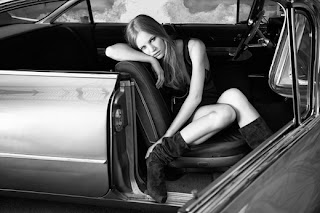
The other 2 are shown as interior shots, the middle one shows not only the interior but you can also see the exterior, with the lighting being very even over the whole image. The exterior is not visible in the last image with all the lighting being concentrated within the car interior. They are both taken with a fairly wide lens to get the whole of the interior in. The detail shown is very good and clear. Again the black and white images are outstanding.

This is the Corniche, but the sun was very bright at this time and the owner had run off with the keys!!!!!!!!! so we could not move it!!

An early shot of Emma getting out of the Rolls. No extra lighting used here.

This is focusing on Emma's necklace.

Again focusing on Emma's necklace whilst relaxing in the Farrari

A close up of Emma's necklace.


Help, my car's broken down.

This was the outfit that we choose for Emma to start with. Focusing on the necklace again.

well just relax and change shoes

blond and Farrari, whatever next?
Oh to do it all again now that I have a better understanding of how to light the subject, and get more detail and varience in the accessories.
Now the influences for the above
There are several photographers that I have studied and they are:-
William Metcalf
 |
| This is an advert for the car (but not for stockings!) |
Reinfried Marass
Short bio- born 1960 in Vienna. Started photography at 18 after graduating as a mechanical engineer. The positioning and relationshiop of points, lines and areas in his photos are influenced and dictated by the "Bauhaus", that combined crafts and Fine Art. His work is done by avaiable light and he says he has not used a flash or similar lighting equipment. He comments "I'm a strict follower of the 'the codex'-the unwritten 'contract' between the photographer and the viewer. This contract states that the photograph must reflect the truth. Digital post-produssing used in a minimalist way, just to enhance the technical quality-not to create fake shots fake light situations. In my opinion 'sticking to this rule' becomes even more important in the digital era of photography". He has posted many images and has a large number of books published. His abilty to capture the image infront of him shows his talent and craft.


The above image is stated by Reinfried as "perhaps the most beautiful image I have ever posted..." Circa 2009.
I particulary like the way the sun has been handled in 2 of the images, as this is a tricky lighting to capture without blowing all the highlights. I especially like the black and white rendition, and the way the background is completely out of focus. There is showing a reflection in the mirror of the lady in the second one.The bottom one shows how to get out of the car, and althought the lady does not show her face we have the anticipation of her emerging from the car.
Mark Peterman


The one above has been taken from above giving a good shot of the interior, and also the illusion of movement with showing the gravel outside the car. Again this looks like it was taken in sunlight and the contrast has been handled well here. The second image has been taken through the glasss and the lighting has been thrown onto the girls face. This is in direct contrast to the one above where the shot is taken to the inside of the car. Both shots show the interior of the car in 2 different ways.
Gabriele Rigon


Th ewonderful portrait in the mirror is what grabbed my attention, combined with the out of focus background, but shows the elegant location this image was taken. The first image is very well composed and the angles lead you all round the image. The black and white effects work really well here, as well as the focusing and contrasts, with even lighting all round.
David Perry
Short bio -Born 2/11/59 given first camera at 10, but was an 8mm movie camera.Studied photography at Art Centre College of Design, and opened his first studio in 1986. By 1991 he ahd begun documenting ans romanticizing the enrging underground hot rod and pin-up culture in California. he has had books and exhibitions world wide.


The other 2 are shown as interior shots, the middle one shows not only the interior but you can also see the exterior, with the lighting being very even over the whole image. The exterior is not visible in the last image with all the lighting being concentrated within the car interior. They are both taken with a fairly wide lens to get the whole of the interior in. The detail shown is very good and clear. Again the black and white images are outstanding.
Subscribe to:
Posts (Atom)